Where does the gas come from?
Start with the available supply, its location and the connection to your site.
 Discuss a project
Turning gas access into practical infrastructure for the industries that need it.
Explore the supply routes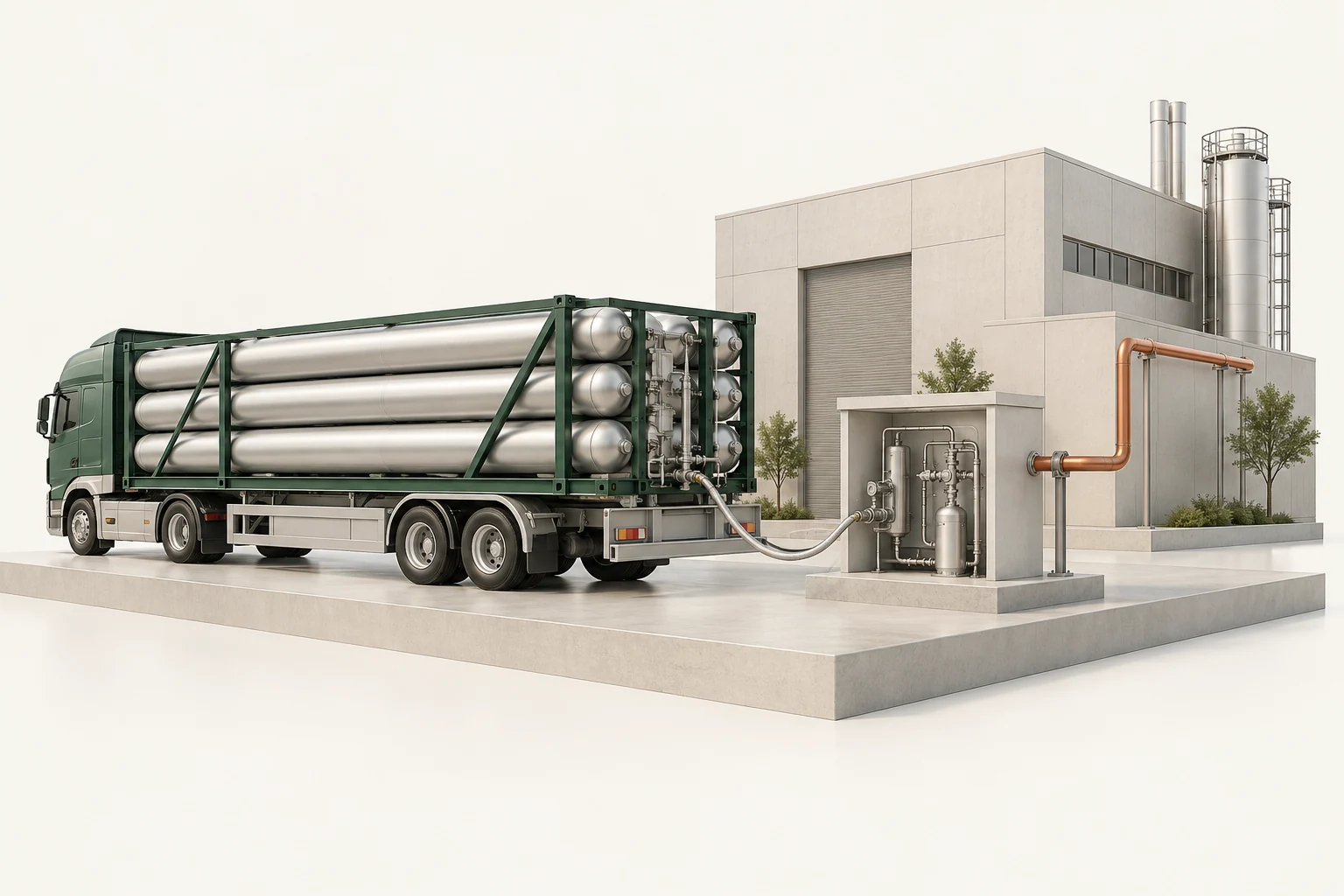
A viable supply route must connect with a facility’s demand, receiving infrastructure and operating needs.
Start with the available supply, its location and the connection to your site.
Understand the process, consumption profile and pressure requirements at the point of use.
Consider the receiving site, operating team and maintenance needs from the outset.
Pipeline, compressed natural gas (CNG) and liquefied natural gas (LNG) connect supply with demand in different ways.
Compare supply access, demand, transport distance and site conditions together.
Then define the infrastructure needed at each end of the connection.
Explore the receiving systemGas is compressed for transport, then its pressure is reduced and its delivery metered at the receiving site.
Gas is compressed for transport, then its pressure is reduced and its delivery metered at the receiving site.
Gas is cooled into liquid for transport, then returned to gas through regasification before delivery to the industrial user.
A pipeline connects supply to the receiving facility, with pressure regulation and metering suited to the end use.
Simplified process routes. The receiving arrangement and supply chain depend on the selected concept and project requirements.
Read about CNG and LNG at the U.S. Department of Energy ↗ and LNG transport and regasification at the U.S. EIA ↗.
APICAL’s natural gas focus includes pressure regulating and metering systems for industrial users and distribution networks.
Bring filtration, regulation and measurement into a coordinated receiving arrangement.
Define the connection between the supply infrastructure and the needs of the receiving user.
Engineering, procurement support, installation and operations, shaped around the needs of the project.
Frame the demand profile, supply access and site constraints before comparing delivery concepts.
Frame the demand profile, supply access and site constraints before comparing delivery concepts.
Develop the selected concept around pressure regulation, metering and the interfaces with the industrial facility.
Support equipment procurement, installation, testing and commissioning against the agreed project requirements.
Bring maintenance, technical assistance and operator training into the operating plan for the facility.
Tell us about your location,
current fuel and operating needs.
We can begin there.